Knowledge Database rubber-technology

Our knowledge base consolidates expertise on elastomers, composite parts and toolmaking. Here you’ll find precise information on materials, processes and applications - clearly explained and technically sound. It’s ideal for engineers, purchasers and anyone with a technical interest who wants to dive deeper into the world of rubber technology.

Knowledge Base-Radio Filter
Choose Category
Knowledge base (Blog) Categories
Diagram showing, from left to right, milling, die-sinking EDM and the CAD system. These three components are the main components of GUME GmbH's internal toolmaking department
CNC milling and EDM
CNC milling and die-sinking EDM in toolmaking: Functionality, differences and interaction between the two processes and their influence on precision and quality.
Header Process article: Additive
Additives
Additives in elastomer compounds control processing, ageing resistance, cross-linking and functional properties. Overview of mechanisms of action, additive classes and technical classification.
Header Process article: Additive
Primer
How can rubber be bonded to a substrate (metal)? Basics, function and process reliability for primer application.
Chemical composition of the polymer chloroprene (CR)
CR - Chloroprene
Chloroprene (CR): Properties, chemical structure, processing, relevant standards and material comparison with other synthetic rubbers explained in compact form.
Chemical composition NBR (nitrile butadiene rubber)
NBR - Nitrile Butadiene Rubber
NBR (nitrile butadiene rubber) is an oil and fuel-resistant synthetic rubber characterised by good mechanical properties and high resistance to mineral oils.
FKM header: Chemical structure of the FKM copolymer
FKM - Fluororubber
FKM refers to fluorinated elastomers with a saturated polymer main chain. Overview of chemical structure, processing, standards and material comparison.
EPDM - Ethylene Propylene Diene Monomer - Chemical structure of the terpolymer
EPDM - ethylene propylene diene monomer
EPDM is a synthetic rubber based on ethylene-propylene. Overview of structure, properties, processing and categorisation in a material comparison.
Header BR - Butadiene rubber: Chemical composition
BR - Butadiene Rubber
Butadiene Rubber: Properties, Benefits, Typical Applications, where BR excels and what it is used for - compactly summarized.
IR - Isoprene Rubber
Isoprene Rubber (IR): Quick check of Properties, Limitations and Common Fields of Application - explained in an easy-to-understand way.
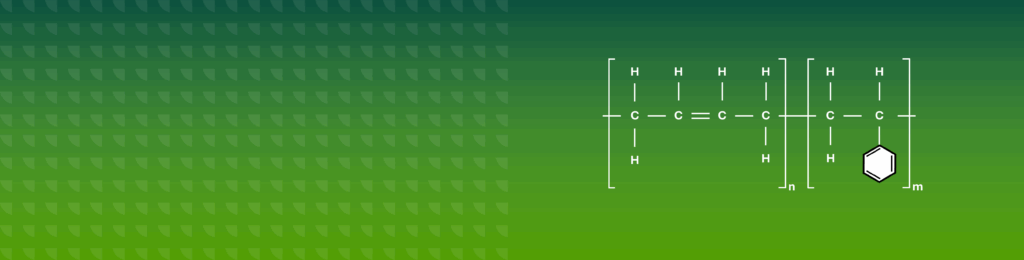
SBR - Styrene-Butadiene Rubber
Styrene-Butadiene Rubber (SBR) is one of the most widely used synthetic rubbers worldwide. As a cost effective alternative to natural rubber, SBR combines good processing properties, high availability and abrasion resistance - a material with both history and future.
Long transparent silicone strips in mould - freshly pressed
Compression Molding of Elastomer Parts
Operating principle, typical applications, material advantages, and tooling design – including temperature management & design considerations.
Injection moulding - machine working and running at full speed
Injection Molding for Rubber and Silicone Components
Injection molding: short cycle times, high dimensional accuracy, and low material waste. Explore when this process excels over compression molding.
Illustration of a transfer moulding process
Transfer Molding of Elastomer Parts
Operating principle, advantages, and differentiation from compression and injection molding.