








Bespoke silicone switch mats

We manufacture custom silicone keypads for industry at our factory in Bavaria, according to your requirements. As a silicone keypad manufacturer, we support you in the design of your silicone keypad to create defined force-displacement curves, tactile and acoustic feedback, and backlighting that suit your application.

Silicone switch mats, switch mat systems and keycaps
Made to measure by the manufacturer

Our silicone switch mat systems are produced according to individual customer requirements. Therefore, single pushbuttons, key combinations or entire keypads are possible. Depending on whether the silicone switch mat is located under a button cover or is to be operated directly, we will gladly produce your switch mat including labelling. Switch mats can, even if they are mainly used as Silicone moulding manufactured, also as Rubber moulding or as a composite part of RUBBER AND METAL, Rubber and plastic and Rubber and fabric be produced.

These Companies trust in us

Kundenlogo der Blaser Group.
Krones company client logo.
PARI logo and lettering
Customer logo of 2R: An R in red and an R in blue. An outer circle in red and blue
ASMPT_Logo

Structure of silicone keypads

Silicone keypad mats are often intended to replicate a defined haptic feel in the form of force-displacement curves, in order to produce a uniform and application-specific button-pressing sensation. Through individual adjustment of Shore hardness, A bespoke silicone switch mat is created through wall thickness and geometry, which precisely matches your requirements and exact tactile feedback.

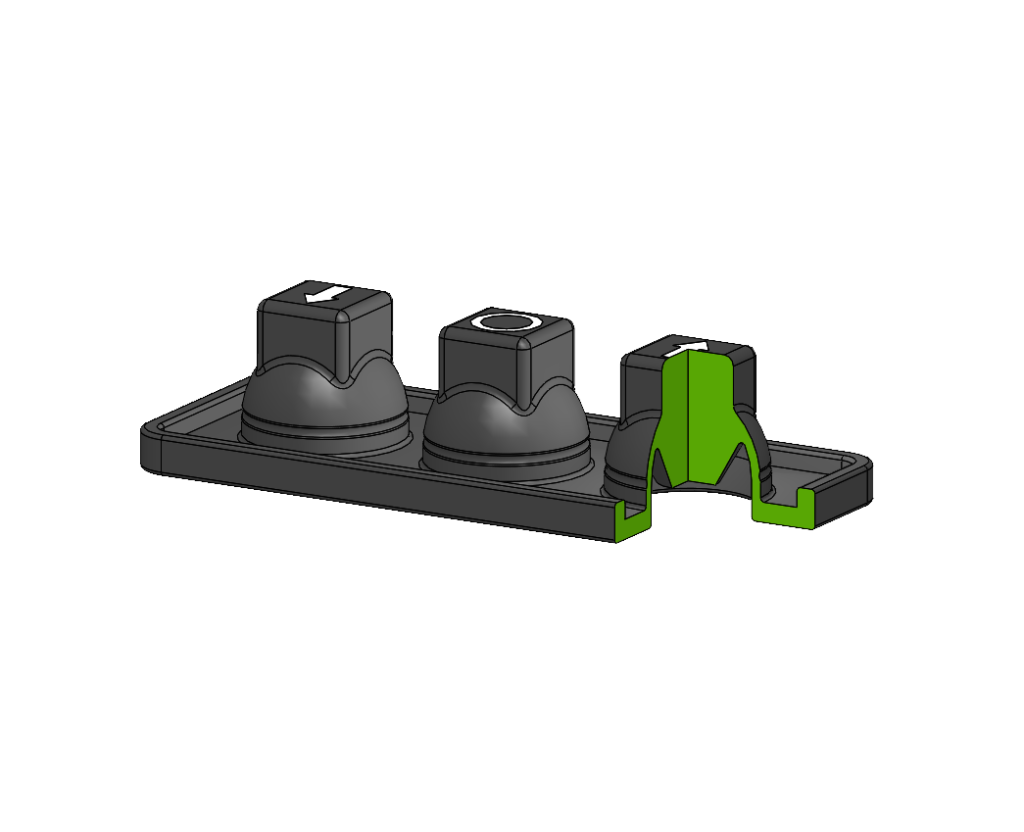
CAD modelling of a silicone switch mat. One area of the switch mat is shown as a cross-section.

Dome geometry
The shape of the dome determines the haptic experience when switching. A high, strongly domed cap produces crisp, clearly perceptible feedback with pronounced hysteresis, while a flat cap reacts more softly and progressively. Oval or rectangular base areas allow for space-saving arrangement while adapting to the key geometry.

Hub

Hub
The travel describes the distance the slider moves until the switching point. A long travel conveys a deliberate, controlled switching sensation and is suitable for applications where accidental actuations are to be avoided. A short travel, on the other hand, allows for quick, low-latency inputs on the silicone switch mat and is preferred in slim, space-critical devices.

Wall thickness
The wall thickness of the dome affects the actuation force and the lifespan of the silicone switch mat. Thinner walls reduce the necessary actuation force and increase sensitivity but are more susceptible to material fatigue at high switching frequencies. Thicker walls increase the actuation force and robustness, but require more effort from the user and can harden the tactile feedback.

Nauseate
The ribs are circumferential indentations or structures at the base of the dome that influence the buckling behaviour of the cap. They define the buckling point more precisely and ensure more uniform force distribution when pushed through. This allows the hysteresis of the force-distance curve to be specifically adjusted – for a more sharply defined or softer shifting feel.

Basis
The base forms the load-bearing element of the silicone switch mat and connects all domes to a single component. Its thickness and geometry determine mechanical stability and resistance to dust and moisture. The base also integrates fastening and positioning structures into the silicone switch mat, ensuring precise and stable mounting in the housing.

Contact surface
The type of contact used determines the signal quality and application area of the silicone keypad. Conductive carbon pills are the standard solution for cost-effective mass applications with sufficient contact resistance. Gold-plated contacts offer significantly lower and more stable resistance of the silicone keypad and are used where low signal levels, long service life, or medical requirements necessitate reliable and long-term stable contact.


Optional snap discs

Optional snap discs
By integrating a metal snap disc beneath the silicone dome, the switching feel is fundamentally changed. The disc creates a very abrupt, metallic-crisp engagement with high hysteresis upon exceeding the switching point, which significantly deviates from a pure silicone dome. This is particularly suitable for applications where unambiguous, haptically distinct feedback is required.

Optional dual-stage

Optional Two-stage
A two-stage dome geometry allows for two independent switching functions within a single key element. The first pressure point triggers a pre-action, and further pressing activates the main function. This design is typical for camera shutters, safety applications, or complex control devices, where a deliberate two-stage input increases operational safety and functional depth.

Materials for your Bespoke silicone switch mats

Compared to other elastomers, silicone has the lowest hysteresis. This means that the force required to activate a key and the return force are relatively similar. Silicone is therefore mostly used when explicit resistance to chemicals, oils, fuels, etc., is not desired. As a manufacturer of switch mat systems, we process all common Elastomers.

We will advise you on the suitable material for your silicone keypad. Contact us!

Industrial applications of Silicone keypads

In most applications with pushbuttons, silicone switch mats are also installed. Switch mat manufacturers therefore supply a variety of industries, with the design always tailored to the specific application – short or long strokes, firm or soft pressure points, large and small buttons in a custom number and arrangement.

Silicone switch mats in the Industrial automation and in mechanical engineering

Silicone switch mats are widely used in control panels, operating panels, emergency stop units and handheld remote controls for cranes or machinery. Other elastomer switch mats are less common, as robustness against oil, dust and mechanical stress, as well as high switching reliability, are particularly required, even under adverse environmental conditions.

Silicone switch mats in the Metrology

Handheld measurement devices, multimeters, calibrators, and laboratory analysis equipment use silicone switch mats because precise, reproducible switching force and long-term stable hysteresis are crucial for these applications. Incorrect operation due to an unclear switching feel is unacceptable in this environment, as it can directly affect measurement accuracy and operational safety.

silicone switch mats Automotive, agricultural and construction machinery manufacturing

In tractors, combine harvesters and excavators, silicone switch mats in joysticks, steering wheel control units and external control panels manage functions such as the three-point linkage, power take-off, and working hydraulics. Constant vibration, extreme temperatures and dust-intensive environments place high demands – the reproducible tactile feedback ensures safe operation, even when wearing protective gloves.

GuMe Logo

We are your partner for industrial silicone keypads! Test us!

GuME Logo

Insights in silicone keypad projects
of our customers.

Case study: Silicone switch mats in very wide temperature operating conditions

The challenge

A customer in the electronics industry required a silicone switch mat that could be used in both Arctic cold and desert heat. Furthermore, the switching feel had to be consistent, follow a predefined force-displacement curve, have thin wall thicknesses of 0.6 mm, and not fail even after millions of actuations.

Process

Based on the requirements specification, GUME created a prototype tool with an initial test geometry. After measuring the first silicone keypad prototypes, receiving customer feedback, and making minor adjustments to the specifications, the prototype tool was repeatedly revised in an iterative process to capture the final geometry within a few weeks.

Solution

Within a few weeks, as silicone keypad manufacturers, we were able to construct the final design and subsequently transfer it into a production tool. Thanks to our in-house engineering, toolmaking, and GUME production, the goal was not only achieved in terms of quality but also realised in a particularly short timeframe of just 6 weeks.

Do you have questions about silicone switch mats?
We have answers!

Silicone is the preferred material for switch mats because it provides a stable, reproducible force-displacement characteristic over the entire operating range. The low compression set, the permanent resilience from –60 °C to over 200 °C, and the precise processability of fine dome geometries make it superior to other elastomers. EPDM Offers advantages in outdoor applications with high UV and weather exposure while simultaneously meeting low-cost requirements. NBR is then the better choice when direct and permanent contact with fuels or mineral oils is unavoidable.

Labels on silicone switch mats are applied using various methods depending on the requirements. Screen printing is the most economical solution for large quantities, but it reaches its limits with intensive mechanical stress. Laser labelling creates sharply contoured, abrasion-resistant markings without applying ink and is particularly suitable for high demands on long-term readability. Sophisticated applications rely on multi-layer coating with laser engraving, where the laser selectively removes paint layers, creating high-contrast, high-precision labels with maximum Abrasion resistance generated. For backlit variants, switch mat manufacturers use translucent silicone combined with opaque paint layers, which are selectively exposed by laser in the illuminated areas. For particularly abrasion-resistant applications, a transparent top coat is applied to the switch mat system to further protect the paint.

The switching point is the defined moment during the actuation of a silicone condom when the dome mechanically collapses and closes the electrical contact. In the force-displacement curve, it is described as the point where the applied force reaches its maximum and then drops abruptly – the so-called peak force or snap-through. It is precisely this drop in force that produces the perceptible tactile feedback. The switching point is defined by the dome geometry, wall thickness, and material hardness, and is measured as a combination of switching force in Newtons or grams and the corresponding switching travel in millimetres.

Silicone keypads typically achieve a lifespan of 1 to 5 million actuation cycles, with significantly more in optimised designs. The actual number of cycles is heavily dependent on the dome geometry, wall thickness, actuation force, and environmental conditions. Not only the mechanical wear of the silicone is crucial here, but especially the wear of the conductive contact pill, which strikes the printed circuit board's conductor traces with every actuation. Gold-plated contacts achieve significantly higher cycle counts than standard carbon pills, as they ensure a stable, oxidation-free contact resistance over their entire service life.

Yes, silicone switch mats can be made from LSR These are manufactured using. The injection moulding process enables fully automated production, short cycle times and high reproducibility even for complex dome geometries – particularly economical for large production runs. The main disadvantage lies in the high tooling costs: LSR tools require significantly higher investment than conventional tools due to the necessary precision and automation. Compression moulding-Tools and are therefore often uneconomical for small and medium batch sizes.

The tactile feedback of a silicone switch mat refers to the haptically perceptible response that the operator feels when actuating a dome with their finger. When pressing the silicone switch mat, the counter-force increases up to the switching point and then drops sharply – this characteristic buckling of the dome conveys clear information to the operator that the switching process has been triggered, without the need for visual or acoustic feedback. The quality and nature of the tactile feedback are determined by the dome geometry, the wall thickness, the material hardness, and the hysteresis of the force-displacement curve.

Yes, custom silicone switch mats are available in antistatic and ESD-safe versions. Conductive fillers such as carbon black are used to specifically adjust the surface resistivity in order to prevent uncontrolled electrostatic discharges that can damage sensitive electronics on the circuit board. Such versions are primarily used in the electronics industry, medical technology, and in areas with a risk of explosion.

The sample release process begins with the joint definition of technical requirements – dome geometry, switching force, stroke, contact type, and labelling – based on a product specification or drawing. Subsequently, as a silicone keypad manufacturer, we not only produce the first sample but also the associated individual mould in our toolmaking department beforehand. To verify the properties, the prototype silicone keypads are measured in terms of their force-displacement curve and compared with the defined tolerances for switching force, hysteresis, and stroke. In parallel, a visual inspection of the geometry, surface quality, and labelling is carried out. Following the customer's approval of the samples, tooling and process parameters are fixed and documented in an initial sample inspection report, which forms the basis for series production release.

You want a Have a silicone switch mat manufactured? We advise you!