








Industrial metal and plastic enclosures

We are a manufacturer of industrial enclosures. Our strengths lie particularly in Rubber metal connections and Rubber Plastic Compounds for industrial enclosures with integrated, vulcanised-on seals, to customer-specific requirements.

Bespoke industrial enclosures Directly from the manufacturer

With our own machining centres and plastic injection moulding machines at our plant in Bavaria, we produce Tools and housings from small to large series of several hundred thousand pieces per year. Our custom industrial housings are manufactured to customer specifications and are supplied with a matching vulcanized seal to reliably protect the housing interior from dust and dirt.

Specific metal alloys for special applications

Metal casing

Precision housing with a form-fitting elastomeric seal for reproducible measurement conditions

Measurement technology housing

Medical technology housings with silicone seal, cleanroom-compatible and sterilizable

Medical technology enclosures

IP-rated electronic enclosure with continuous profile gasket to IEC 60529

Electronic Enclosures

Aluminium housing with integrated sealing element for reliable sealing of the housing interface.

Aluminium casing

Stainless steel housing with integrated seal for reliable sealing of the housing interface.

Stainless steel casing

Plastic housing with function-integrated seal for reliable sealing of the housing parting line.

Plastic housing

These Companies trust in us

Krones company client logo.
PARI logo and lettering
Customer logo of 2R: An R in red and an R in blue. An outer circle in red and blue
ASMPT_Logo

Customisations for your industrial enclosures with integrated seal

As manufacturers of casings, we always produce casings with integrated seals to order and individually. Therefore, you can influence all parameters. We manufacture your industrial casings according to your drawings and also vulcanise the casing seal directly onto the casing or lid. To ensure the right solution for every application, we select the most economical manufacturing process for your industrial casings – for example, milled from solid material, or extruded profiles with subsequent Milling, turned housing parts, injection-moulded as thermoplastic, etc.

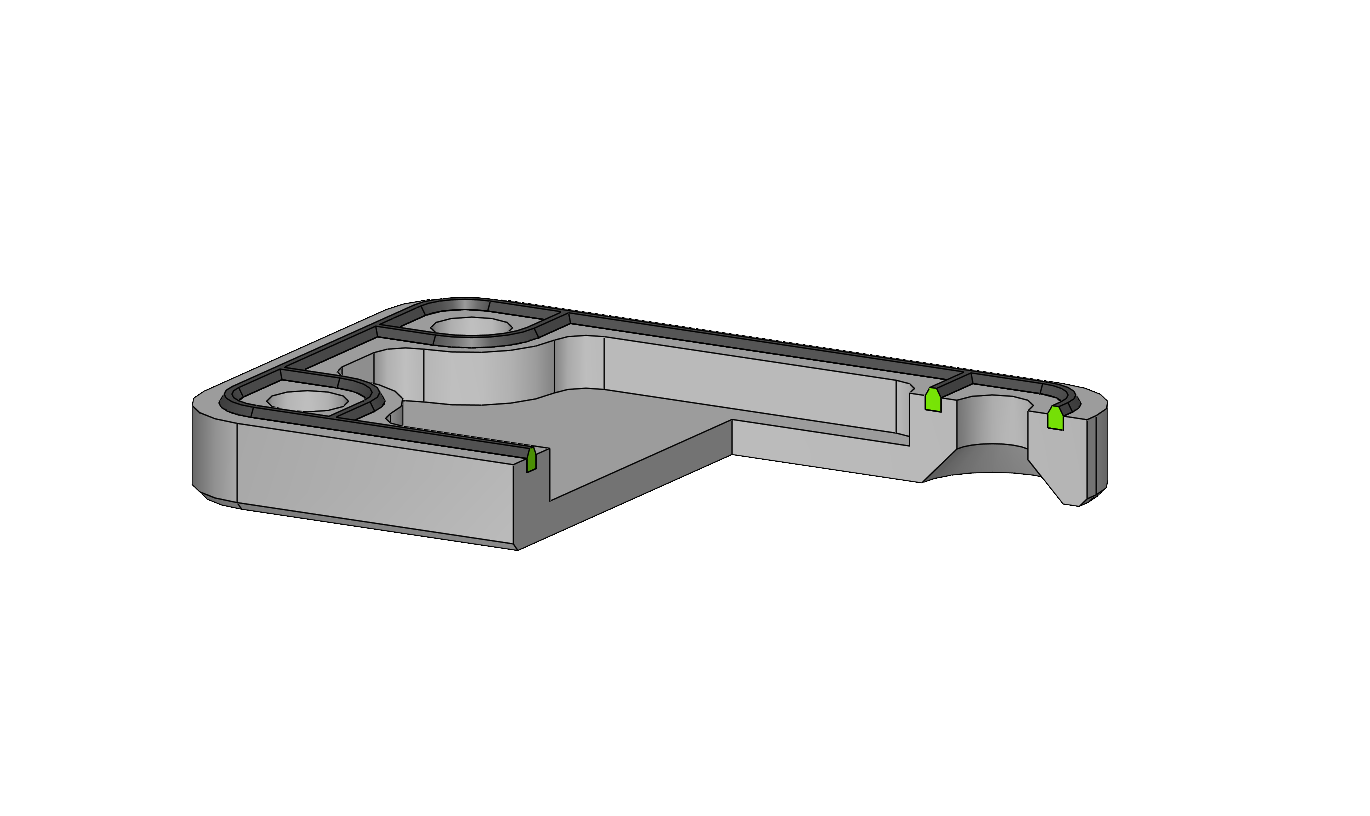
Cross-section of a housing with seal.
Surface treatment

Surface treatment
A surface treatment – such as painting, powder coating, galvanising, nickel plating, or anodising – protects the custom industrial enclosure from corrosion, chemical attack, and mechanical wear, and is selected according to the application.

Casing geometry

Casing geometry
The external and internal geometry of an industrial enclosure determines assembly compatibility, force transmission, and heat dissipation. Round cross-sections offer optimal pressure distribution. Rectangular shapes facilitate spatial integration. Ribs or steps can be specifically used for stiffening or for positioning attachments.

Case height and dimensions

Case height and dimensions
The casing height and external dimensions define the available installation volume, weight, and compatibility with the surrounding space.

Wall thickness
The wall thickness determines the mechanical rigidity and compressive strength of the industrial housing. Greater wall thicknesses increase load-bearing capacity against external forces and internal pressure, but also increase weight and material costs. Thin-walled designs are suitable for weight-optimised applications with lower mechanical requirements.

Gasket
The co-vulcanised seal ensures a permanent, positive-fit seal between the industrial housing and the cover. In contrast to loose seals, the risk of positional errors is eliminated. The seal geometry and Shore hardness of the elastomer determine the compression, the sealing range, and the resistance to media and temperatures.

Lid
The cover forms the end of the custom industrial housing and, together with the vulcanised-in seal, forms the sealing system. The material and wall thickness of the cover influence the overall rigidity and deformation behaviour under internal pressure. Depending on the design, the cover can be implemented as a welded, screwed, or clipped connection.

Fastening
Threaded holes and flanges enable detachable, high-load connections with defined preload for maintenance-intensive applications. Clip elements and snap connections in custom industrial housings are used for faster, tool-free assembly in series production. Press fits and welded joints offer maximum rigidity for permanent, vibration-loaded installation situations.


Manufacture custom industrial housing parts

The name GUME stands for our core competence: the in-house processing of rubber and metal.

For you as a customer, this means a clear advantage: we handle both the metal processing and the vulcanisation of the rubber entirely in-house. This way, you receive rubber-metal components, including sealing function, from a single source. Instead of having to coordinate two separate manufacturers for the housing and the seal, with GUME you have just one point of contact who reliably covers the entire process.

01

Concept development

At the beginning of every project lies the development of a well-thought-out housing concept. Together with our clients, we develop a design that is suitable for manufacturing and meets both technical requirements and economic framework conditions. We provide comprehensive advice on the selection of suitable materials and lay the foundation for safe, efficient, and series-ready implementation at an early stage.

03

Casing manufacture in metal or plastic

In parallel, production of the housing components begins. Metal housings are machined on specially developed clamping towers. This well-thought-out clamping concept allows for a high degree of automation and helps to make production economically viable and competitive, even at the German site. We manufacture plastic housings using injection moulding and tailor the process here to the specific requirements of each project.

02

Toolmaking and mould making

Based on the agreed concept, the necessary tools and moulds for subsequent seal vulcanisation are created in our in-house toolmaking department. The close integration of development and toolmaking allows us to precisely address the requirements of the respective component and create the conditions for economical and process-reliable production.

04

Surface finishing, vulcanisation and dispatch

Depending on the component and requirements, the housing parts undergo corresponding surface finishing before or after mechanical processing. For visible components, this is usually carried out beforehand. Subsequently, the seal is directly vulcanised onto the blank housing or lid using the transfer or compression moulding process. After successful completion, the components are packaged ready for shipment and delivered on time. Upon request, we also handle storage until the material is needed later.

Advantages vulcanised seals

A housing seal prevents dust, dirt, or moisture from entering between the industrial enclosure and the cover. The basic principle is based on surface pressure: the sealing material conforms to any surface irregularities in the industrial enclosure. Common methods include inserted flat gaskets, seal cords in grooves, or adhesive seals. However, weaknesses such as slipping, assembly errors, or ageing of the adhesive occur with all these variants.

Advantages at a glance:

GuMe Logo

Industrial enclosures for various industries

GUME housing components are used in many industries. Anywhere, for example, where electronic components need to be protected from the environment, custom-made industrial housings are used, which are precisely tailored to the application.

Housing with seal in the Medical Technology

Industrial enclosures for surgical instruments, laboratory equipment and diagnostic systems must withstand the highest hygiene requirements. Our enclosure parts can withstand repeated sterilisation and the use of aggressive disinfectants, are fully batch traceable, and protect sensitive device contents from contamination.

Housing with seal in the Metrology

Industrial housings for length measuring devices, test bench sensor technology and analysis equipment protect the sensor technology from media, pressure and temperature influences. Precisely vulcanised elastomer seals ensure stable measurement conditions – even with chemical contact, vibrations or changing environmental conditions.

Housing with seal in the Electrical engineering

Control and power electronics for outdoor use or in manufacturing are protected by our industrial enclosures with integrated seals. Frequency converters, control units and power supplies with a circumferential profile seal meet the highest protection classes – and permanently keep out dust, moisture and spray water.

GuMe Logo

Housing with seal - Manufactured entirely in-house at GUME.

GuME Logo

Frequently Asked Questions to industrial enclosures with integrated sealing

Plastic housings are lightweight, corrosion-resistant, and cost-effective. They are suitable for applications with low mechanical stress, electrical insulation, or complex geometries in large quantities. Metal housings made of aluminium or stainless steel offer higher strength, better heat dissipation, and are suitable for demanding environments with high pressures, temperatures, or mechanical loads – for example, in measurement technology, medical technology, or mechanical engineering.

For IP67 (brief immersion) and above, a pre-vulcanised seal is recommended. It is materially bonded to the housing, cannot slip or be forgotten, and delivers consistently reproducible sealing results – even with vibration, temperature changes, and frequent assembly. Inserted seals are often sufficient for IP54 to IP65, but require careful assembly and regular checks for wear and correct seating. Therefore, for economic and quality reasons, pre-vulcanised seals can also make sense for lower protection classes.

The choice of material for housing seals depends on the operating conditions. NBR is suitable for contact with oil and fuel, for example, in mechanical engineering. EPDM performs well against weathering, water, and weak acids in outdoor housings. FKM offers maximum chemical and temperature resistance up to over +200 °C and is used in the process and chemical industries. Silicone is particularly suitable for medical technology and food-related applications thanks to its biocompatibility and sterilizability. CR (Neoprene) scores points in areas with fire protection requirements. HNBR is recommended for dynamically stressed seals due to its high wear resistance. However, there is no one-size-fits-all recommendation – we are happy to advise you on your custom industrial housing and the right seal.

Industrial enclosures generally exhibit reliable behaviour at extreme temperatures, but react with material-specific thermal expansion. At high temperatures, enclosures and seals expand, which can lead to stresses at the joining points if there are different coefficients of expansion. Aluminium expands more than steel and therefore requires careful design when subjected to temperature changes. At low temperatures, sealing rubbers can become brittle and lose their sealing effectiveness. Through appropriate material and seal selection – such as silicone seals for a wide temperature range – industrial enclosures can be designed for temperatures from -50°C to over 200°C.

Manufacturability-focused design reduces scrap, setup times, and rework right from the development stage. Optimised sealing geometries shorten vulcanisation cycles, while well-thought-out clamping concepts increase the degree of automation in milling operations. Those who procure toolmaking, manufacturing, and assembly from a single source avoid interface losses and delays. In the long term, process-reliable designs also lower complaint costs and extend the service life of components in use. At GUME, you get everything from a single source. Get in touch with us for your housing parts.

Cable entries in industrial enclosures are designed differently depending on the requirements for sealing, strain relief, and EMC. The simplest and most cost-effective solution is the rubber grommet, which is inserted into a bore, protects the cable from sharp edges and provides basic sealing. For higher protection requirements, cable glands made of metal or plastic are used, which simultaneously ensure strain relief and IP protection. For EMC-critical applications, shielded cable glands with direct shield connection to the enclosure are used. Blanking plugs permanently and reliably seal unused openings.

You want a Housing with seal To have manufactured?
We will advise you