What is hard rubber?
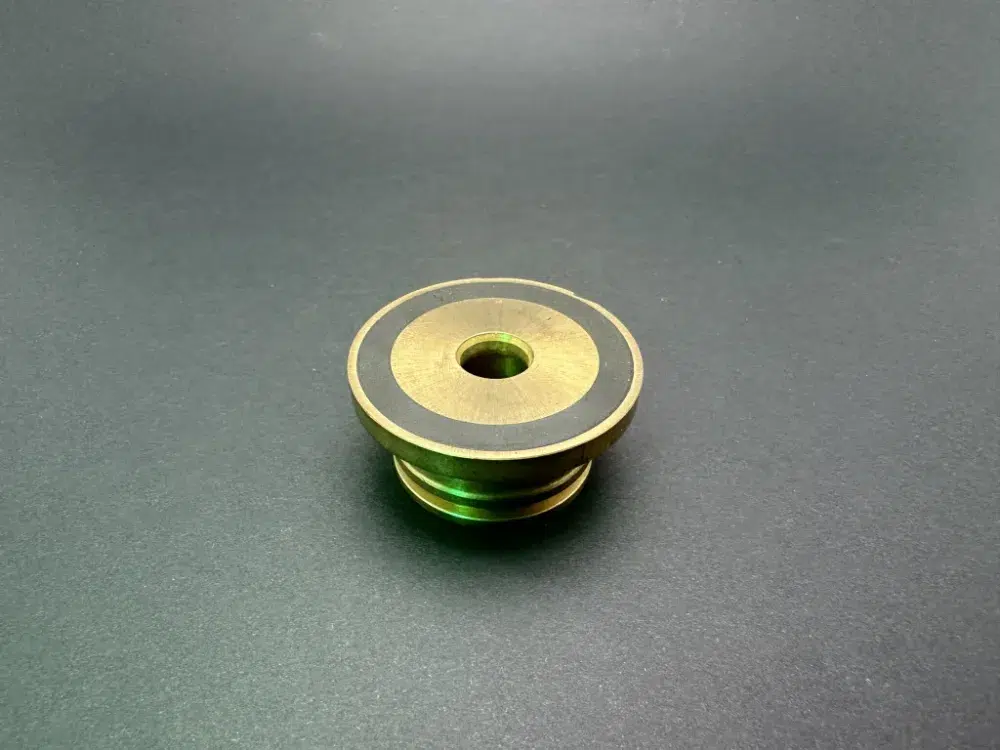
Hard rubber, also called Ebonite, is a hard, no longer rubber-elastic material that is produced by vulcanizing rubber with a very high sulfur content. The polymer chains are so tightly interconnected that hard rubber behaves like a hard plastic. Hard rubber can be processed and polished by friction, is electrically insulating, and is resistant to many chemicals. The English term is „hard rubber“ or „ebonite“.
| Characteristic | Indication |
|---|---|
| Designations | Hard rubber, ebonite, vulcanite (English:hard rubber, ebonite) |
| Starting material | Rubber with many double bonds, especially natural rubber, as well as SBR and NBR |
| Networking | Sulfur, usually 30 to 40 parts per 100 parts of rubber |
| Hardness | about 70 to 85 Shore D |
| Mechanical behavior | rigid and brittle, not rubber-elastic |
| Softening | from about 70 to 80 °C for hard rubber made from natural rubber |
| Processing | Manufactured by pressing or extruding using vulcanization. Subsequent machining by turning, milling, drilling, grinding, polishing |
How is hard rubber formed?
Hard rubber is produced, like soft rubber, through the Vulcanisation of rubber with sulfur. The difference lies in the amount: soft rubber contains only a few parts of sulfur per 100 parts of rubber, hard rubber usually 30 to 40 parts. At this amount, the sulfur reacts with most of the double bonds in the polymer chains. The network becomes so dense that the chains can no longer move against each other, and the material loses its rubber elasticity.
Only rubbers with many double bonds are suitable for hard rubber; especially natural rubber, but also SBR and NBR. Copolymers with few or no double bonds, such as EPDM or silicone, cannot be crosslinked into a hard rubber.
The vulcanization of hard rubber takes significantly longer than that of soft rubber and releases a lot of heat in the process. In thick-walled parts, this reaction heat can build up and lead to bubbles or cracks. Hard rubber is therefore heated slowly and under controlled conditions. Hard rubber dust as a filler further dampens the heat development.
What properties does hard rubber have?
Hard rubber combines the hardness and form stability of a plastic with the chemical resistance of rubber. Its properties differ significantly from those of an elastomer in six points:
- Mechanical behavior: Hard rubber is hard, form-stable and pressure-resistant. It is at the same time brittle and susceptible to impact and breaks without visibly deforming beforehand.
- Chemical resistance: Hard rubber is resistant to many acids, alkalis and salt solutions and hardly absorbs water. Oxidizing acids and some solvents attack hard rubber.
- Electrical properties: Hard rubber is a good electrical insulator.
- Temperature behavior: Hard rubber softens when heated. Hard rubber made from natural rubber begins to soften at about 70 to 80 °C and then deforms under load.
- Light and aging: Under light and moisture, the surface of hard rubber turns from black to brown to greenish-yellow, becomes matte, and loses its insulating properties.
- Processing: Hard rubber can be turned, milled, drilled and polished to a high gloss finish.
What is the difference between hard rubber and hard rubber?
Hard rubber and hard rubber are two different materials. In everyday life, rollers, buffers or plates made of hard rubber mixtures are also called „hard rubber“. Technically, these are elastomers with a high Shore A hardness that continue to deform rubber-like. Hard rubber in a technical sense is ebonite: rigid, brittle and no longer rubber-like.
The difference lies in the cause of the hardness. A hard elastomer becomes hard due to a high filler content; its crosslinking remains extensive. Hard rubber itself becomes hard due to the crosslinking, because the high sulfur content tightly binds the polymer chains together.
| Characteristic | Hard rubber (ebonite) | Hard elastomer |
|---|---|---|
| Hardness | about 70 to 85 Shore D | about 80 to 95 Shore A |
| Behavior under load | rigid, brittle | rubber elastic, returns to its original shape |
| Elongation at break | few percent | mostly over 100 % |
| Cause of the hardness | Thick network due to high sulfur content | High filler content |
| Design | Forming, followed by frequent machining | Shapes in the tool |
| Typical components | Sheaths, insulated parts, mouthpieces | Rollers, buffers, deflector plates, hard seals |
GUME did not manufacture hard rubber products, but only hard ones. Silicone-, and Molded Rubber with up to 95 Shore A.
Is hard rubber the same as ebonite?
Yes. Hard rubber, ebonite and vulcanite all refer to the same material. The name ebonite comes from the word „ebony“, English "ebony".