




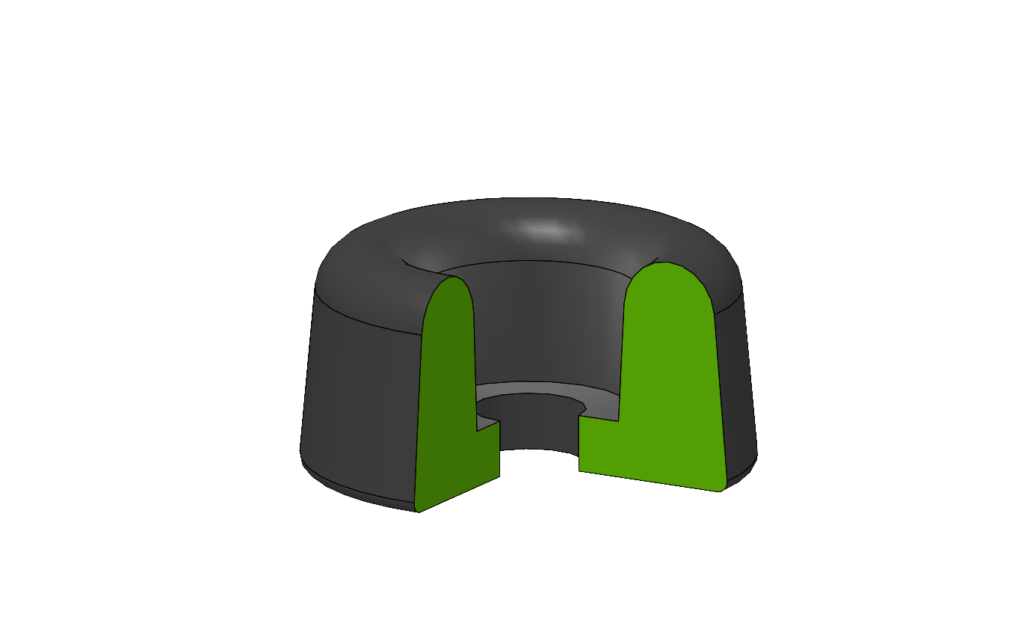
Rubber buffers for the industry
We produce our rubber and silicone buffers individually according to your specifications. We process all common elastomers in flexible batch sizes and, if required, provide advice on design and material selection. .
- Customised production
- Batch sizes 1 to 1 million units.
- Express production from 2 weeks
- 100% Reliability & proactivity
Rubber buffers & silicone buffers for the industry
Rubber buffers for industry are moulded rubber parts, silicone moulded parts or TPE moulded parts for the elastic absorption and damping of mechanical loads between two components. They reduce shocks, vibrations and noise by converting kinetic energy into heat through elastic deformation. In this way, a rubber buffer protects machine components and decouples vibrating systems. At our factory in Bavaria, we exclusively manufacture customised rubber buffers based on your requirements.
Customised geometries for special installation situations.
Special shapes Buffer
Cylindrical buffer for absorbing pressure loads in solid construction.
Cylinder buffer
Buffer with cavity or hole in the centre for progressive damping.
Hollow buffers
Elastic end stop for shock absorption of moving machine parts.
Stop buffers
These Companies trust in us
Structure & function of a rubber buffer for the industry
Our rubber buffers for industry are specially tailored to your application and are produced for you individually with your own mould from our toolmaking department. As a rubber buffer manufacturer, we are happy to adapt the geometry so that the desired spring characteristics or a specified damping behaviour can be achieved even with limited installation space.
Buffer height
As the height increases, the possible deformation path of the rubber buffer increases. This reduces the effective spring stiffness and the buffer can absorb more energy. A lower height leads to a stiffer characteristic and reduces the maximum possible stroke under load.
Buffer outer diameter
A larger diameter increases the loaded area of the rubber buffer and therefore the transmittable compressive force. At the same time, the stiffness increases as the rubber buffer can expand less laterally. A smaller diameter, on the other hand, reduces the load-bearing capacity and leads to a softer spring behaviour with the same overall height.
Form factor
The form factor describes the ratio between the loaded surface and the freely expandable side surfaces of a rubber buffer. A high form factor occurs when the lateral expansion of the rubber buffer is limited. This increases the effective stiffness of the rubber buffer. A low form factor allows greater lateral expansion, which makes the buffer softer and provides more deformation path for energy absorption.
Wall thickness
With hollow buffers, greater wall thicknesses increase the load-bearing capacity and limit elastic deformation. Thinner walls allow greater expansion and therefore higher energy absorption, but can reduce the maximum load-bearing capacity of the buffer.
Inner bore
A larger cavity reduces the effective cross-sectional area of the rubber buffer. This makes the buffer softer and can absorb greater deformation paths. A smaller inner bore, on the other hand, increases the amount of material in the cross-section and leads to higher rigidity and greater load-bearing capacity.
Buffer geometry
Cylindrical buffers usually have a relatively linear spring characteristic and are suitable for uniform pressure loads. Conical or profiled buffers produce a progressive characteristic curve in which the stiffness increases with increasing deformation. Rectangular, usually elongated buffers distribute forces over larger contact surfaces and often exhibit a more rigid, load-stable behaviour.

Materials for silicone and rubber buffers for industrial applications
Matching the rubber material to the individual working environment determines how long the rubber buffer will remain usable. As a manufacturer of rubber buffers for industry, we process all common elastomers and will be happy to advise you on the choice of material.
EPDM buffer
Absorbs shocks in outdoor installations, resistant to water, UV, ozone and weathering
NBR buffer
Shock and vibration damping in oil and fuel-loaded machine environments
HNBR buffer
Highly resilient buffer for dynamic shocks with oil contact and increased temperatures
Silicone buffer
Temperature-stable damping buffer for extreme heat, cold and sensitive environments
SBR buffer
Robust shock absorber for general machine applications and moderate environmental conditions
FKM buffer
Chemical and temperature-resistant buffer for aggressive media and industrial processes
TPU buffer
Wear-resistant buffer for high mechanical loads and abrasive operating conditions
Buffer special geometries
Customised rubber or silicone buffers for challenging applications & industries
Contact us for customised material advice on your requirements.
Sectors / Applications of Rubber buffers for the industry
Rubber and silicone buffers are used in industries such as mechanical and plant engineering, robotics and automation as well as railway technology.
They are used to dampen forces, provide elastic support for components and reliably reduce vibrations, shocks and noise during operation.
Buffer in the Mechanical Engineering
Typical applications for limiting impact forces are end stops on linear axes, stop buffers on slide guides, damping elements in conveyor systems or protective buffers on machine doors. In presses, packaging machines and handling systems, they are used to elastically brake moving assemblies when they reach their end positions and to protect mechanical components such as bearings, guides or housings from overloading.
Buffer in the Robotics and automation technology
In dynamic motion sequences, rubber buffers are used in industry to limit movements and dissipate impact energy in a controlled manner. In robotics, buffers are used for end stops on linear units of gantry robots, damping buffers on gripper modules, stops on pick-and-place systems or protective buffers.
Buffer in the Railway technology
Stop buffers in coupling systems, damping elements on wagon transitions and impact buffers on shunting and stabling systems absorb kinetic energy during shunting movements or when wagons start up. This protects structural components, couplings and running gear components from excessive loads.
35 years of expertise in the manufacture of buffers!
Test us!
- Toolmaking is our core competency
- 100% in-house expertise
- Fast response times for tooling modifications
Puff success stories from the industry
Iterative product development and project management
The challenge
Assistance
Solution
Do you have questions about rubber buffers for industry?
We have answers!
The Shore hardness influences the damping and spring characteristics of a rubber buffer.
Softer elastomers (e.g. 40-50 Shore A) deform more under load, providing greater travel for energy absorption and more effective shock absorption. Harder rubber buffers (e.g. 60-80 Shore A) have greater stiffness and transmit forces more directly, increasing the spring characteristic. In addition to hardness, geometry, form factor and material damping also influence dynamic behaviour. The selection of Shore hardness is therefore always made in combination with the component geometry and the expected load.
The geometry of a rubber buffer influences its energy absorption in several ways.
The energy absorption of a rubber buffer is determined by its design, wall thickness, cavities, and the so-called shape factor, which is the ratio of the loaded area to the free expansion area. Cylindrical or solid geometries lead to higher stiffness and limit the deformation path. Hollow or conical elastomer buffers, on the other hand, allow for a progressive spring characteristic and greater deformations, thereby absorbing more energy. Through targeted (iterative) adjustment of the buffer geometry, the damping and spring behaviour of a rubber buffer can be adapted to the dynamic load of the application. As experts and rubber buffer manufacturers, we are happy to support you in the development of your special rubber buffer.
How do temperature and ageing affect the properties of a rubber buffer?
At elevated temperatures, thermo-oxidative processes in the elastomer accelerate, which can lead to an increase in crosslink density, hardness, and compression set. Conversely, low temperatures result in increased stiffness and reduced elasticity. In addition, chemical influences, ozone, UV radiation, and long-term mechanical stress affect aging. These factors alter the damping and spring characteristics and can lead to cracking or material embrittlement in the long term. Contact us to select the appropriate rubber material for the maximum service life of your rubber buffer, tailored to your application.
What typical damage patterns occur with overloaded rubber buffers?
Overloaded rubber buffers typically show signs of damage such as cracking, severe permanent deformation (compression set) or detachment of metal parts in rubber-metal connections. Material fatigue also frequently occurs due to cyclical loading or localised overstretching, particularly at notch points or transitions. This damage leads to a change in the spring characteristic curve, reduced damping performance and ultimately to a loss of function of the rubber buffer.
How are rubber buffers manufactured at GUME? Discover our versatile buffer solutions!
Our standard delivery time for rubber buffers is approximately 8 weeks. However, for urgent development projects, sample parts can be provided within 2 weeks. Depending on the geometry and quantity, manufacturing is carried out using injection moulding or compression moulding processes, allowing for flexible batch sizes. The component range extends from small buffers weighing around 10 g to massive versions weighing up to 5 kg. To precisely meet your requirements, we process all common elastomers and special compounds.